The Last 72 Hours: What to Text Before Polls Close
October 27, 2026
The Last 72 Hours: What to Text Before Polls Close
November 3rd is basically in sight. But by the last three days before Election Day, the job changes from changing minds to making sure the people already on your side actually cast a ballot.
That makes the final 72 hours the most valuable window in any get-out-the-vote (GOTV) program. Supporters are busy, distracted, and often unsure of the basics: where their polling place is, what time it closes, or whether their mail ballot still counts. A well-timed text answers those questions before they become reasons to stay home.
Texting is built for this moment. Messages are read quickly, replies come in real time, and volunteers can hold hundreds of one-on-one conversations in the time it takes to knock on a handful of doors. With Prompt.io™, campaigns can run that outreach from one platform, with opt-outs and list management handled along the way.
Below is a countdown playbook: what to send at 72, 48, and 24 hours out, and on Election Day itself, with sample scripts you can adapt.
72 hours out: ask supporters to make a plan
The first text of the countdown should get a commitment, not just deliver a reminder. Research on voter turnout has consistently found that people who say when and how they will vote are more likely to follow through.
Ask a simple, specific question that invites a reply:
Hi [First Name], it's [Volunteer] with [Organization]. Election Day is Tuesday, [Date]. Do you know when you'll vote: early, by mail, or on Election Day?
The replies give you more than a pledge. They sort your list for the next 72 hours. Tag each answer so the following texts can be tailored:
- Voting early: send early voting locations and hours.
- Voting by mail: confirm their ballot is returned, or share drop-box locations and deadlines.
- Voting on Election Day: move them into the polling place reminder track.
- Unsure or undecided about voting: flag for a personal follow-up from a volunteer.
Keep this first message short and human. A question that sounds like it came from a neighbor will get far more replies than a block of text that reads like an ad.
48 hours out: remove the logistics barriers
Two days before the election, the biggest threat to turnout is friction. Supporters who intend to vote still skip it when they are not sure where to go, what to bring, or whether they missed a deadline.
Use this send to answer those questions before they are asked:
[First Name], your polling place is [Location Name], [Address]. Polls are open [Open Time] to [Close Time] on Tuesday. Need a ride or have a question? Just reply here.
For mail voters, the message should focus on deadlines:
Hi [First Name], have you returned your mail ballot yet? In [State], it must be [received by / postmarked by] [Deadline]. Drop boxes near you: [Link].
A few rules of thumb for this stage:
- Personalize the location. Pull polling place data into the message instead of linking to a generic lookup tool whenever you can.
- Verify every fact against official sources. Polling hours, ID rules, and ballot deadlines vary by state and sometimes by county. Check them with the state or local election office before you send.
- Invite replies. Every question a supporter texts back is a barrier you can clear in real time.
24 hours out: the Election Eve reminder
The night before is about recall and resolve. Remind supporters of the plan they made and give them one reason it matters.
[First Name], tomorrow's the day! You said you'd vote [in the morning / after work]. Your polling place: [Location]. Polls close at [Close Time]. This race could come down to a few votes. Thanks for making your voice heard.
Send this in the early evening, well inside standard sending hours, when people are planning the next day. Reference the time they gave you in the 72-hour conversation. Echoing someone's own commitment back to them is more persuasive than a generic "don't forget to vote."
This is also the last good moment to reach mail voters who have not returned a ballot. Many states have firm receipt deadlines, so tell them exactly what their options are for tomorrow.
Election Day: morning, midday, and the final push
On Election Day, plan for three waves of texts and stop sending to anyone who confirms they voted.
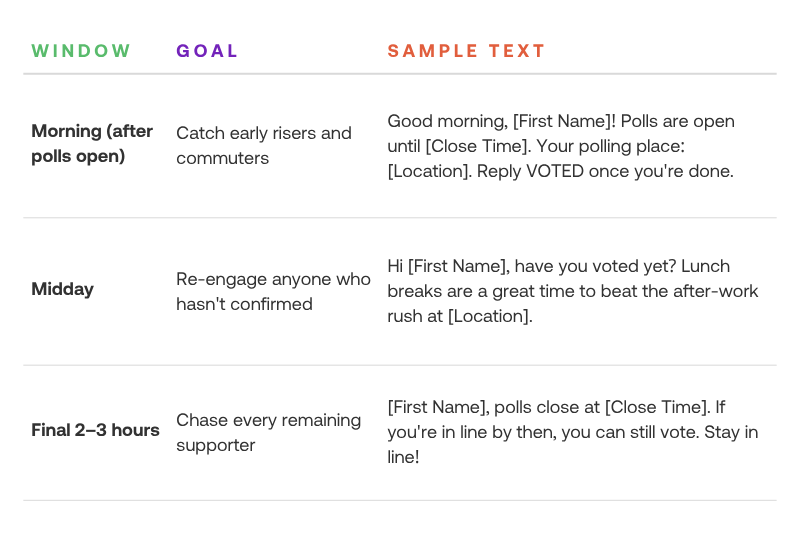
A few details make the final push work:
- Track confirmations. Ask supporters to reply "VOTED" and remove them from later waves. Nobody wants a reminder after they've already cast a ballot.
- Mind the time zones. Polls close at different times across and even within states. Segment by location so every final-hours text lands before that recipient's polls close.
- Repeat the "stay in line" message. In most places, voters in line at closing time can still cast a ballot. Confirm the rule for your jurisdiction, then make sure supporters know it.
- Staff for replies. Election Day replies spike. Have volunteers ready to answer questions about polling places, ID, and provisional ballots, and to route urgent problems to your voter protection team.
[Read More: Your 2026 Elections Guide]
Make every text count before polls close
The final 72 hours reward campaigns that were prepared. Register your numbers early, build your segments now, and draft your countdown scripts before the weekend. Then, when the pressure peaks, your team can focus on conversations instead of logistics.
Note: This blog does not contain legal advice, please consult your legal counsel before implementing any suggestions posted here.
Our latest blog posts
The Last 72 Hours: What to Text Before Polls Close
13 Election Day Texting Tips to Keep Your Messages Delivering in 2026